PROJECT MANAGEMENT

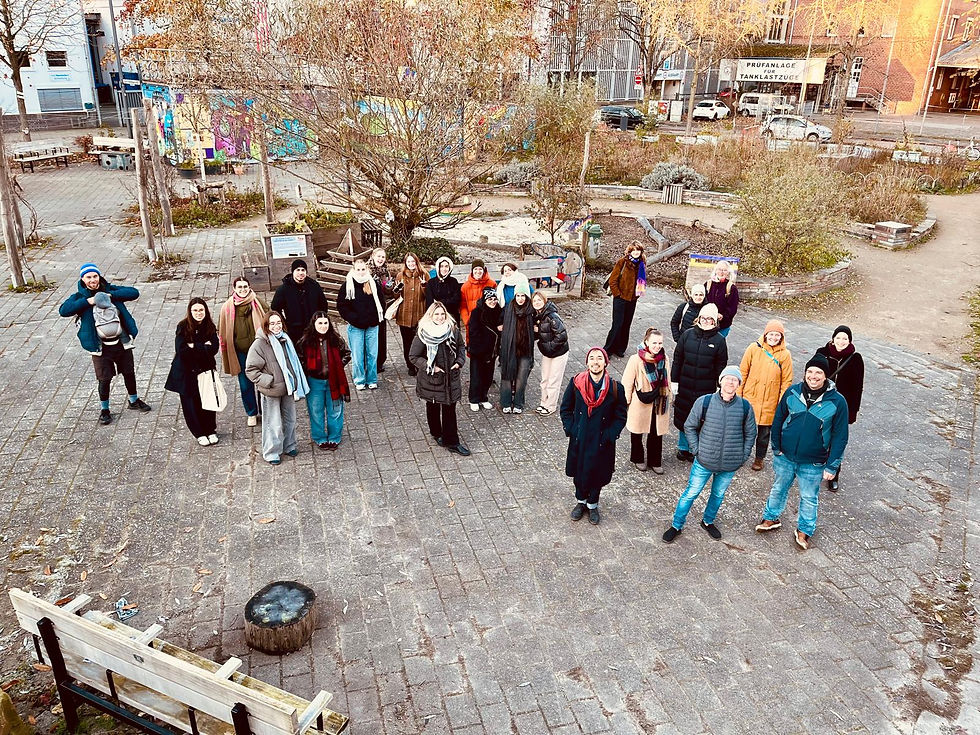
International Conference SoilCities – Theoretical Insights and Action Pathways to Soil-Sensitive Urban Planning and Architecture, Bremen University of Applied Sciences, Bremen, 20.11.-21.11.2025
Coordinators: Christian von Wissel, Valentina Rojas Loa
© Inke Faerber
Bringing together specialists from anthropology, architecture, art, landscape architecture, soil science and urban planning from Europe and Latin America, the conference addressed soil as a decisive force for urban development and explored how restoring soil health can reactivate vital ecosystem services for cities. The conference fostered integrated research and the application of soil health measures in urban and peri-urban contexts, structured around three thematic strands: i) Soil-Sensitive Urbanism: A Comprehensive Vision of Soil for Cities; (ii) Urban Design & Architecture: Soil-Sensitive Cities, Public Spaces and Buildings; (iii) Hands-On: Concrete Measures for Soil-Sensitive Cities and Soil Literacy.
With contributions from: Jana Crepon (Landscape Architect, Partner at Inside Outside, Amsterdam; Ignacio Farías (Urban Anthropology, Institute for European Ethnology, Humboldt University of Berlin); Alan Vergnes (Centre d’Écologie Fonctionnelle et Évolutive, University of Montpellier Paul-Valéry); Silke Cram (University Program for Interdisciplinary Soil Studies, PUEIS, National Autonomous University of Mexico); Hannes Schwertfeger (bureau baubotanik, Stuttgart; Ingo Vetter (Fine Art, Sculpture, University of the Arts Bremen HfK) and Michelle Howard (Socio-ecological Architecture, Academy of Fine Arts, Vienna.
Upcoming publication: 2026!


Festival Changing City – 50 Years of Public Art in Bremen, Bremen Culture Senator, Gesellschaft für Aktuelle Kunst-GAK, 27.6. - 22. 9. 2023
Director: Valentina Rojas Loa
© Nikolai Wolff
Long regarded as a pioneer of public art policy in Germany, Bremen today holds a remarkable catalogue of around 680 artworks distributed throughout the urban fabric: a living archive embedded in streets, squares, housing estates parks, and hidden corners. The festival Changing City – 50 Years of Public Art unfolded across 28 different walks, talks, and interventions all around Bremen. More than a retrospective celebration, the festival was an opportunity to revisit five decades of artistic production in public space, to confront the current challenges facing public art, and to experience the city itself differently: as a contested cultural landscape shaped by memory, politics, participation, and urban transformation. Alongside an exploration of Bremen’s public art heritage and numerous best-practice examples from across five decades, the anniversary programme aimed to situate the city’s experience within broader international debates and within the context of new social, political, and economic pressures shaping contemporary urban life and current public art practices.


Die Bremen Sprachmusikanten, Multilingual Audiobooks, Literaturhaus Bremen, 2023
Direction and Production: Valentina Rojas Loa
Conceptualization and production of the Bremen Sprachmusikanten, the famous Town Musicians Story told in the 16 most spoken languages of Bremen: German (Easy Language), Plattdeutsch, German Sign Language, Turkish, Spanish, Arabic, Ukrainian, Twi, Polish, Kurdish, Korean, Russian, Italian, French, English and Bulgarian. With Hubertus Hess-Grunewald, President of Werder Bremen as the narrator of the German Version.
Highlight project of Bremen City of Literature 2023!

UNIQUE Mut.Macht.Mode.
A workshop for girls on fashion, identity and socio-ecological transformation, Bremen Nord, 2022
Concept: Valentina Rojas Loa, Claudia A. Cruz
Artistic Director: Claudia A. Cruz
Coreography: Anna Jäger Music: Flo Mega
What does fashion mean to you? Who decides what is beautiful, feminine, powerful or acceptable? In this hands-on workshop, girls were invited to tear fashion apart and remake it on their own terms. Together with Bremen-based artist and designer Claudia A. Cruz, participants experimented with designing, sewing, upcycling, and explored the social, personal, cultural, and ecological realities stitched into the clothes we wear every day. From fast fashion and body politics to identity, sustainability, and self-expression, fashion became more than style: it became a tool of resistance, empowerment and change.