ALL PROJECTS


Exhibition WE ARE THE RIVER – What Connects Us With the River Weser, 21.03.-23.08.2026, Harbour Museum, Bremen
Curators:
Valentina Rojas Loa, Jessica Fritz, Felix Dreesen
Art Installation:
Felix Dreesen
Exhibition Design:
Rainer Weber
© Frank Scheffka
What is a river? And what would it say if it could speak, or rather, if we were able to listen? Through conversations with those who know the Weser most intimately, We Are the River... brings to the surface some of the quieter, yet no less important, voices of the river. Among them are an inland boatwoman, a forester, a logistics director, a biologist, a lawyer, and a poet, birds and mollusks, as well as advocates for the rights of the river as a living subject and holder of rights. The exhibition presents these interviews alongside a series of objects floating in tanks filled with river water, where life slowly unfolds over the course of the exhibition. At its center stands Felix Dreesen’s monumental 20-ton stone installation, reproducing the river one-to-one as a “heavily modified water body.” Over centuries, industrial stones, metal and plastic have transformed the river in an anthropocenic landscape. And yet the river is alive. And it revolts.


DeichTRIFT City Center – A Multifocus Research on the River Weser, Exhibition, Research, Performative Lunch, Open-Air Kino, Raumlabor UMZU, Bremen, 19.09.2024 (International River Day)
Curators: Valentina Rojas Loa, Susanne von Essen und Felix Dreesen
Artists: Beate C. Koehler; Felix Dreesen; Nikolai Wolff, Kay Michalak and Tristan Vankann
© Jasper Wessel
DeichTRIFT was a multi-perspective research project on the Weser River that brought together diverse forms of knowledge to explore socially and ecologically responsive ways of relating to the river in times of climate crisis. The project investigated how the spatial potential of both city and river in Bremen can be reimagined and redefined. Moving between past, present, and possible futures, DeichTRIFT examined the historical and contemporary uses of the Weser while creating new connections between established institutions, emerging initiatives, researchers, artists, activists, and communities working with the river. DeichTRIFT understood the river not only as infrastructure or landscape, but as a living political and ecological space — one that challenges us to rethink urban life, coexistence, and responsibility in an era of climate crisis and environmental transformation.


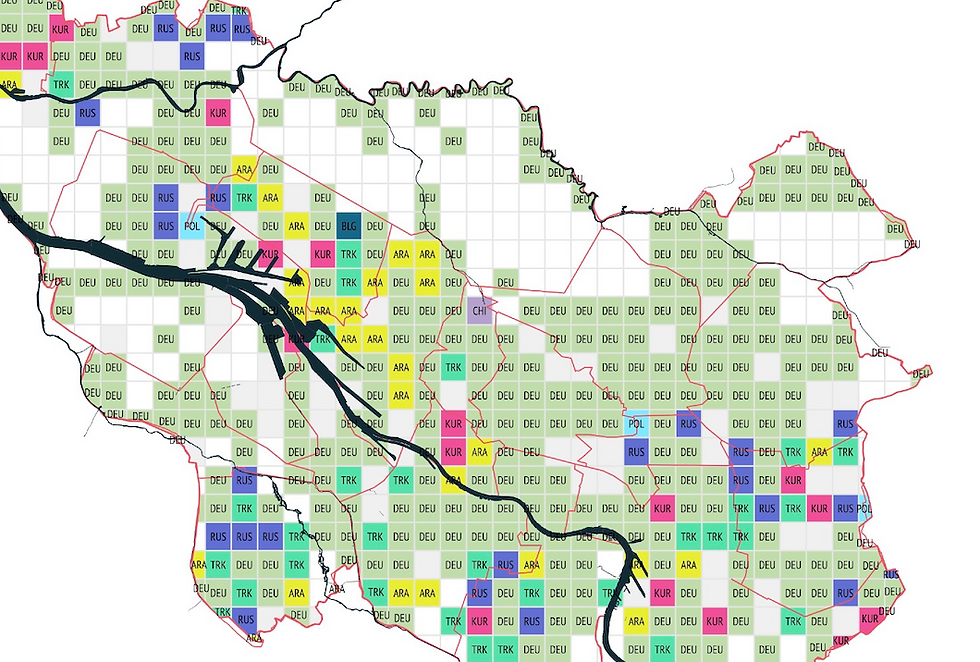
Exhibition Bremen speaks – a Cartography of Bremen’s Multilingualism, Focke Museum, 05.03.-29.05.2022
Curators: Valentina Rojas Loa and Maria Mazolli
Linguistic Maps: Vittorio dell’ Aquila
© Nikolai Wolff
Through a series of groundbreaking sociolinguistic maps — developed for the first time in this form in Germany — this exhibition revealed the hidden linguistic landscape of the city. Which neighborhoods hold the greatest linguistic diversity? How do languages inscribe themselves into the fabric of the city? Based on data provided by Bremen’s Senator for Education, the maps made visible a reality that often remains unseen. Bringing together speakers, activists, educators, policymakers, administrators, and social scientists, the exhibition was a multilingual conversation itself, creating a space where different perspectives collided, interacted, and reshaped one another. Together, these voices challenged dominant ideas about language, identity, and belonging, transforming Bremen’s linguistic diversity from an overlooked fact into a shared social and cultural resource.


Touring exhibition Citámbulos – A Journey to the Mexican Megalopolis, German Centre for Arquitecture, Berlin, 2008; National Museum of Anthropology, Mexico, 2009; Upper Austrian Architecture Forum, Linz, 2010; City Museum, Copenhagen, 2011.
Curators: Valentina Rojas Loa, Ana Álvarez, Christian von Wissel, Fionn Petch, Vlady Diaz
Museum Design: Luis Rodríguez
© Citámbulos, Till Budde
A touring exhibition on the contemporary life of Mexico City, first conceived for Berlin, transformed itself through dialogue with the urban fabric and inhabitants of each host city — Berlin, Mexico City, Linz, and Copenhagen — evolving into a provocative reflection on “citiness” as a global contemporary phenomenon. In Mexico City, it attracted 277,000 visitors and became the first exhibition at the National Museum of Anthropology — one of the world’s leading anthropology museums — dedicated to contemporary urban life. Developed with more than 120 collaborators, including artists, scientists, urban specialists and inhabitants, the exhibition combined photography, sculpture, games, everyday objects, video, and sound installations, extending beyond the museum walls into public space. Alongside the exhibition, the Urban Age project of the Alfred Herrhausen Society and the London School of Economics, co-produced with Citámbulos and the Deutsche Bank Americas Foundation, organized the Mexico City Symposium, bringing together international experts to debate the future of the Mexican megalopolis.
In 2025, we were thrilled to discover that the Mexican composer Erick Tapia found inspiration in the work of Citámbulos to create a mambo dedicated to Mexico City. If Mexico City sounds like music, it certainly sounds like this!

Exhibition Archive Curating the City – Unpacking Citámbulos, Wagenhalle, Stuttgart, 2012
Curators: Valentina Rojas Loa, Ana Álvarez, Christian von Wissel (Citámbulos)
© Citámbulos
Built from the evolving archives of the touring exhibition Citámbulos – A Journey to the Mexican Megalopolis, which travelled over four years between Mexico City, Berlin, Linz, and Copenhagen, Curating the City – Unpacking Citámbulos turned the exhibition-making process itself into its central subject. Rather than presenting a fixed narrative, this exhibition about an exhibition operated as an open and living archive: a space where research, translation, negotiation, and collective knowledge production remained visible. Drawing from methodologies in sociology, anthropology, urban research, and participatory practices, the project challenged the idea of the exhibition as a finished object, presenting it instead as an evolving social process deeply entangled with the different urban realities in which it unfolded.


Five dérives, a contribution to the exhibition Instant Urbanism, Swiss Architecture Museum, Basel, 2007; Danish Architecture Centre, Copenhagen, 2008; Espai d´Art Contemporani, Valencia, 2008; and Vitruvianum, Heerlen, 2008.
Curators: Valentina Rojas Loa, Ana Álvarez, Christian von Wissel, Daniela Wolf
© Citámbulos
Conceived in dialogue with the parallel exhibition on the history of the Situationist International at the Museum Tinguely, Instant Urbanism revisited the radical legacy of Situationist thought in architecture and urbanism, tracing its theoretical echoes in contemporary spatial practices. Citámbulos contributed to the exhibition through two graphic interventions and five dérives: five audiovisual urban drifts created by the same number of groups of artists inspired by the book Citámbulos: the Incidende of the Remarkable. Guide to the Marvels of Mexico City (2007). The project also included a dérive through the streets of Basel, drawing directly from Guy Debord’s concept of the dérive — an open-ended exploration of the city guided by atmosphere, chance, and psychological encounter between two urban imaginaries — Basel and Mexico City — rather than destination.


Exhibition The Turn of the Bicycle, Franz Mayer Museum, Mexico City, 2016; Museo del Amate, Cuernavaca 2016; Museo Nacional de los Ferrocarriles Mexicanos, Puebla, 2017
Curators: Ana Álvarez, Valentina Rojas Loa
Museum Design: Luis Rodríguez and Nils Dallmann
© Moritz Bernoully
Celebrating one of the most revolutionary inventions in modern history, the exhibition presented the bicycle as a key tool for more sustainable, accessible, and collective forms of mobility. Through 13 thematic sections, it traced the close relationship between the evolution of bicycle design and broader social and cultural transformations in Mexico and around the world, inviting audiences to rethink the bicycle not simply as a means of transport, but as a social, ecological, and cultural force capable of reshaping urban life.
The exhibition featured 52 bicycles from 18 private collectors and 13 manufacturing brands, alongside graphic and audiovisual material from private collections and national archives. It also included an interactive installation that allowed visitors to virtually cycle through the streets of Mexico City, as well as sound, graphic, and audiovisual pieces narrating stories and historical moments connected to cycling culture. Bridging history and future imaginaries, the exhibition also showcased recent technological innovations in bicycle and accessory design. The exhibition received 75,000 visitors.

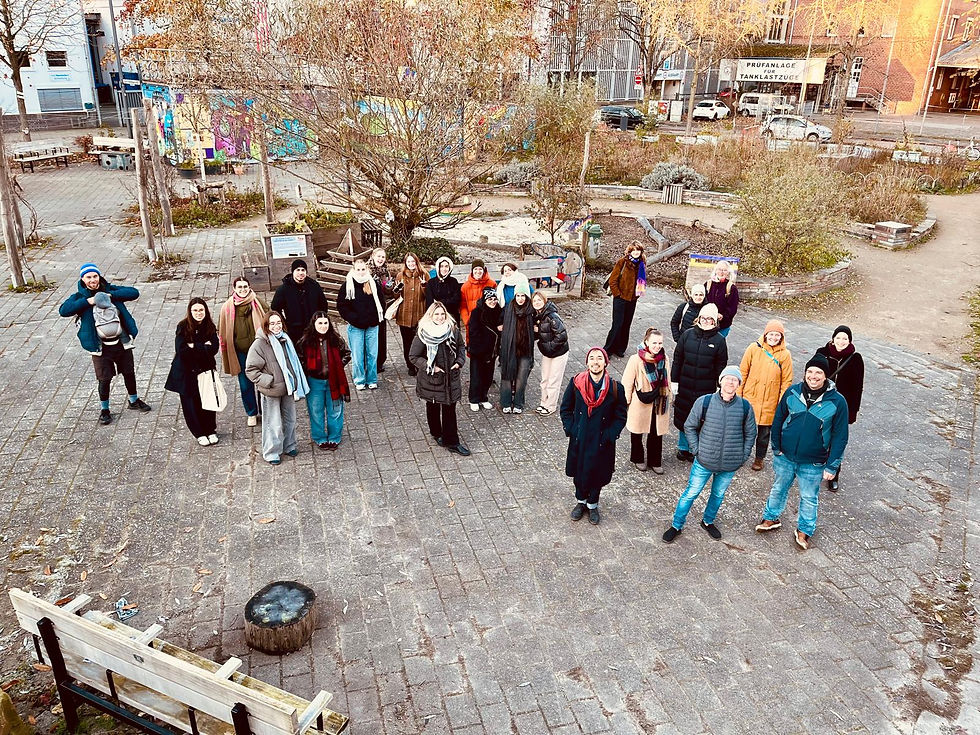
International Conference SoilCities – Theoretical Insights and Action Pathways to Soil-Sensitive Urban Planning and Architecture, Bremen University of Applied Sciences, Bremen, 20.11.-21.11.2025
Coordinators: Christian von Wissel, Valentina Rojas Loa
© Inke Faerber
Bringing together specialists from anthropology, architecture, art, landscape architecture, soil science and urban planning from Europe and Latin America, the conference addressed soil as a decisive force for urban development and explored how restoring soil health can reactivate vital ecosystem services for cities. The conference fostered integrated research and the application of soil health measures in urban and peri-urban contexts, structured around three thematic strands: i) Soil-Sensitive Urbanism: A Comprehensive Vision of Soil for Cities; (ii) Urban Design & Architecture: Soil-Sensitive Cities, Public Spaces and Buildings; (iii) Hands-On: Concrete Measures for Soil-Sensitive Cities and Soil Literacy.
With contributions from: Jana Crepon (Landscape Architect, Partner at Inside Outside, Amsterdam); Ignacio Farías (Urban Anthropology, Institute for European Ethnology, Humboldt University of Berlin); Alan Vergnes (Centre d’Écologie Fonctionnelle et Évolutive, University of Montpellier Paul-Valéry); Silke Cram (University Program for Interdisciplinary Soil Studies, PUEIS, National Autonomous University of Mexico); Hannes Schwertfeger (bureau baubotanik, Stuttgart); Ingo Vetter (Fine Art, Sculpture, University of the Arts Bremen HfK) and Michelle Howard (Socio-ecological Architecture, Academy of Fine Arts, Vienna).
Upcoming publication: 2026!


Festival Changing City – 50 Years of Public Art in Bremen, Bremen Culture Senator, Gesellschaft für Aktuelle Kunst-GAK, 27.6. - 22. 9. 2023
Director: Valentina Rojas Loa
Curatorial Assistant: Anna Blahaut
© Nikolai Wolff
Long regarded as a pioneer of public art policy in Germany, Bremen today holds a remarkable catalogue of around 680 artworks distributed throughout the urban fabric: a living archive embedded in streets, squares, housing estates parks, and hidden corners. The festival Changing City – 50 Years of Public Art unfolded across 28 different walks, talks, and interventions all around Bremen. More than a retrospective celebration, the festival was an opportunity to revisit five decades of artistic production in public space, to confront the current challenges facing public art, and to experience the city itself differently: as a contested cultural landscape shaped by memory, politics, participation, and urban transformation. Alongside an exploration of Bremen’s public art heritage and numerous best-practice examples from across five decades, the anniversary programme aimed to situate the city’s experience within broader international debates and within the context of new social, political, and economic pressures shaping contemporary urban life and current public art practices.


Die Bremen Sprachmusikanten, Multilingual Audiobooks, Literaturhaus Bremen, 2023
Direction and Production: Valentina Rojas Loa
Conceptualization and production of the audiobooks “Die Bremen Sprachmusikanten”, the famous Town Musicians Story told in the 16 most spoken languages of Bremen: German (Easy Language), Plattdeutsch, German Sign Language, Turkish, Spanish, Arabic, Ukrainian, Twi, Polish, Kurdish, Korean, Russian, Italian, French, English and Bulgarian. With Hubertus Hess-Grunewald, President of Werder Bremen as the narrator of the German Version.
Highlight project of Bremen City of Literature 2023!

UNIQUE Mut.Macht.Mode.
A workshop for girls on fashion, identity and socio-ecological transformation, Bremen Nord, 2022
Concept: Valentina Rojas Loa, Claudia A. Cruz
Artistic Director: Claudia A. Cruz
Coreography: Anna Jäger Music: Flo Mega
What does fashion mean to you? Who decides what is beautiful, feminine, powerful or acceptable? In this hands-on workshop, girls were invited to tear fashion apart and remake it on their own terms. Together with Bremen-based artist and designer Claudia A. Cruz, participants experimented with designing, sewing, upcycling, and explored the social, personal, cultural, and ecological realities stitched into the clothes we wear every day. From fast fashion and body politics to identity, sustainability, and self-expression, fashion became more than style: it became a tool of resistance, empowerment and change.

Nine Urban Biotopes -Negotiating the Future of Urban Living, urban dialogues, Johannesburg, Durban, Paris, London, Turin, Berlin, 2015
Director: Stefan Horn
Co-Editor and Researcher: Valentina Rojas Loa
Nine Urban Biotopes – Negotiating the future of urban living (9UB) was an international, socially engaged art project delivering artistic research and cultural exchange. The participating initiatives worked around and responded to issues of safety and housing, youth and migration, education and environment, mobility and economic subsistence. From January through September 2014, nine artistic projects were produced in nine urban settings. Four European artists – Armin Linke, Antje Schiffers, Marjetica Potrč and Anthony Schrag – worked in Johannesburg and Durban, while at the same time five South Africans – Athi-Patra Ruga, Dan Halter, Taswald Pillay, Terry Kurgan and Rangoato Hlasane – worked in Berlin, London, Paris and Turin.


Citámbulos: The Incidence of the Remarkable. Guide to the Marvels of Mexico City, Mexico, 2007
Authors and Editors: Valentina Rojas Loa, Ana Álvarez, Christian von Wissel et.al.
Through the exploration of 121 everyday out of the thousands of hidden marvels of Mexico City, this guide became an invitation for the city’s inhabitants to rediscover their own urban landscape. Radically unconventional for its time, the guide transformed wandering into a form of knowledge and urban curiosity as wells a political and poetic act. It also marked the beginning of over a decade of books, exhibitions, dérives, urban interventions, and conversations with Mexico City — and later with cities around the world — developed by the Citámbulos collective.

Citámbulos – A Journey to the Mexican Megalopolis, Jovis, Berlin, 2009
Editors: Valentina Rojas Loa, Ana Álvarez, Christian von Wissel, Fionn Petc
Graphic Design: Luis Rodríguez
Citámbulos – A Journey to the Mexican Megalopolis was published as the Spanish, German, and English catalogue for the first exhibition of Citámbulos at the German Centre for Architecture in Berlin 2008, yet it quickly transcended the format of an exhibition catalogue to become a journey into Mexico City itself. This catalogue is also a remarkable photographic documentation of Mexico City, bringing together some of the city’s most emblematic photographers of the 2000s, like Dante Busquets, Benjamin Alcantara, Lidia Romero, Mark Powell, among many others.


Perspectivas Latin-Amerika
Heinrich Böll-Stiftung, Berlin, 2017-2020
Co-editor: Valentina Rojas Loa
Perspectivas Latin-America is a multidisciplinary magazine edited by the Latin-America Department of the Heinrich Böll Foundation in Berlin. It offers critical analysis, informed debate, and diverse voices on democracy, social justice, environmental transformation, feminism, human rights, and geopolitical change across Latin-America. Through essays, interviews, and reports, the publication connects regional experiences with global challenges and progressive perspectives.